Sales03@likexin.com
Label procurement avoided high prices but fell into the delivery time trap?

Cynthia Feng
Be your best strong partner.


When sourcing labels, many companies, in an effort to save costs, forgo more professional thermal label sticker factories and choose low-priced label trading companies.
However, they often stumble on delivery times. Production delays, order defaults, and customer complaints follow one after another, ultimately resulting in more harm than good. In modern industrial collaboration, delays in production schedules are more costly than high prices.
However, they often stumble on delivery times. Production delays, order defaults, and customer complaints follow one after another, ultimately resulting in more harm than good. In modern industrial collaboration, delays in production schedules are more costly than high prices.
What Does Unstable Label Delivery Time Mean?
If you are a custom label printing company, a slight fluctuation in material delivery times will force your multi-million dollar printing press to run idle. The loss isn't just in labor costs, but also in the trust of brands.
The unit price for undelivered goods is meaningless, because what's more expensive than high prices is always downtime.
The unit price for undelivered goods is meaningless, because what's more expensive than high prices is always downtime.

Where Do Label Trading Companies Get Their Low Prices?
At this point, you might wonder why some trading companies' quotes are even lower than the cost of raw paper for thermal label sticker factories like ours?
Frankly, they're cutting corners from "unseen" areas.
For example, they might sacrifice delivery time for lower prices, pool leftover inventory for bulk orders, or even squeeze payment terms from upstream and downstream suppliers.
Trading companies don't need professional R&D labs or to test the performance of every batch of adhesive. They excel at scavenging leftover materials that have been stored for over a year in the market.
Trading companies don't need professional R&D labs or to test the performance of every batch of adhesive. They excel at scavenging leftover materials that have been stored for over a year in the market.
Frankly, they're cutting corners from "unseen" areas.
For example, they might sacrifice delivery time for lower prices, pool leftover inventory for bulk orders, or even squeeze payment terms from upstream and downstream suppliers.
Trading companies don't need professional R&D labs or to test the performance of every batch of adhesive. They excel at scavenging leftover materials that have been stored for over a year in the market.
Trading companies don't need professional R&D labs or to test the performance of every batch of adhesive. They excel at scavenging leftover materials that have been stored for over a year in the market.
Why are trading companies more prone to delivery issues than factories?
Because they buy "goods," while we produce "materials."
Trading companies are essentially "mouthpieces," acting as an intermediary with no say in the factory's production schedule.
It's manageable during the off-season, but once peak season arrives, factories prioritize their own orders, and the trading company's customers become the ones sacrificed.
While you're chasing them, they might also be waiting for a response from the factory.
Trading companies are essentially "mouthpieces," acting as an intermediary with no say in the factory's production schedule.
It's manageable during the off-season, but once peak season arrives, factories prioritize their own orders, and the trading company's customers become the ones sacrificed.
While you're chasing them, they might also be waiting for a response from the factory.
Tips: How to Identify if a Supplier is Using Cheap, Inferior Materials
Try pressing the side of the label roll. If it's sticky, the glue has overflowed, and it will definitely stick to the labeler during application.
Alternatively, examine the backing paper under strong light. If the light transmission is uneven and there are cloudy spots, the silicone coating process is flawed, greatly increasing the probability of label slippage and tape breakage during application.
You can even bake a sample label in an oven for two hours. If it turns yellow and bleeds glue, it's a low-quality product lacking antioxidants. Would you dare use such material on your production line?
Alternatively, examine the backing paper under strong light. If the light transmission is uneven and there are cloudy spots, the silicone coating process is flawed, greatly increasing the probability of label slippage and tape breakage during application.
You can even bake a sample label in an oven for two hours. If it turns yellow and bleeds glue, it's a low-quality product lacking antioxidants. Would you dare use such material on your production line?
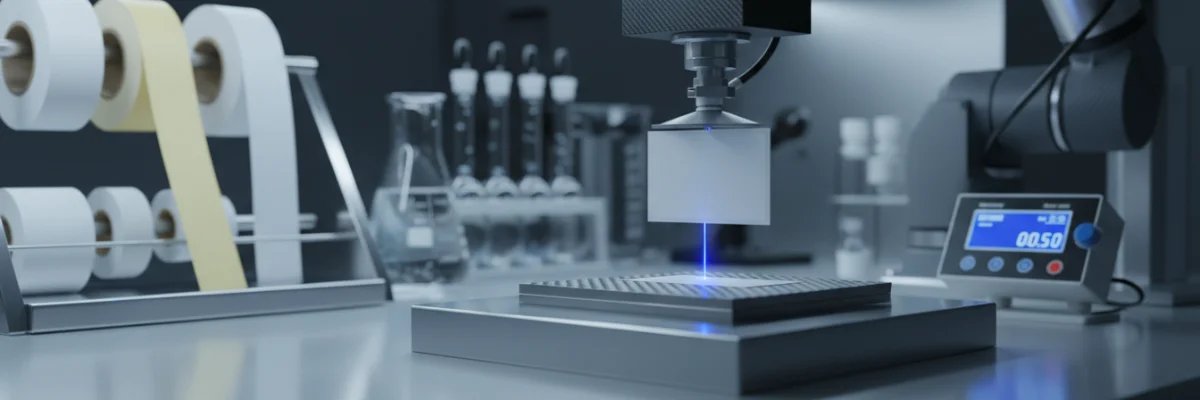
Choosing Certainty is the Highest Level of Purchasing Skill
We don't participate in bottomless price wars because we know that behind every label lies the safety of your customer's entire production line.
We want to give you more than just a label sticker; we want to give you peace of mind.
We want to give you more than just a label sticker; we want to give you peace of mind.